Texas Property Rights and Data Centers

Hey, Texas, let’s talk about property rights and data centers, but from a completely different perspective.
If we concede the argument that the whole data centers/artificial intelligence “race” is indeed a national security issue (which I personally am not yet willing to do), then we must seriously consider every option. After all, most Texans desire a strong America, with a defense that is able to protect our national sovereignty and freedom - so, if we accept that “winning the AI race” is truly national security issue, let’s consider this…
The Federal Government is far and away the largest property holder in the nation. It owns or controls so much land that we have to rely on “best available and broadly accepted” statistics:
Within the 50 states, it is believed the federal government currently owns and manages roughly 640 million acres of land, or about 28 percent of the total U.S. land area. Other estimates, depending on how land holdings and management are counted (for example, whether military lands or certain agency holdings are included), can range up to about 650 million acres, or about 30% of the land area of all 50 states. This 640 -650 million acres number is convenient, as it converts easily to square miles (640 acres/square mile) - so, our US government owns or controls about a million square miles. For comparison, all of our big and beloved Texas encompasses about 268,000 square miles. The Federal government has land holdings in which we could almost place 4 of our Great States!
Now, acknowledging that most of these massive land holdings are in remote areas in the West, I am sure we can find some places to concentrate these data centers. We can find some places where these things don’t directly disrupt and impact the lives of so many citizens. And, if this is truly an existential issue for the United States, then there’s no argument that can be made why this isn’t a viable idea:
Too remote?
It’s a national security issue. Think about the Manhattan Project during World War Two - Los Alamos National Laboratory and the Hanford Site in Washington were created to be remote, away from people. And both of these operations were carved out of the wilderness almost overnight. The too remote argument is actually a massive benefit, as it minimizes the impact of these projects on existing communities.
No water?
It’s a national security issue. The government owns vast land holdings where water is available; and besides, we are being told by the current promoters of data centers that their new closed loop systems don’t really require much water.
No existing Infrastructure?
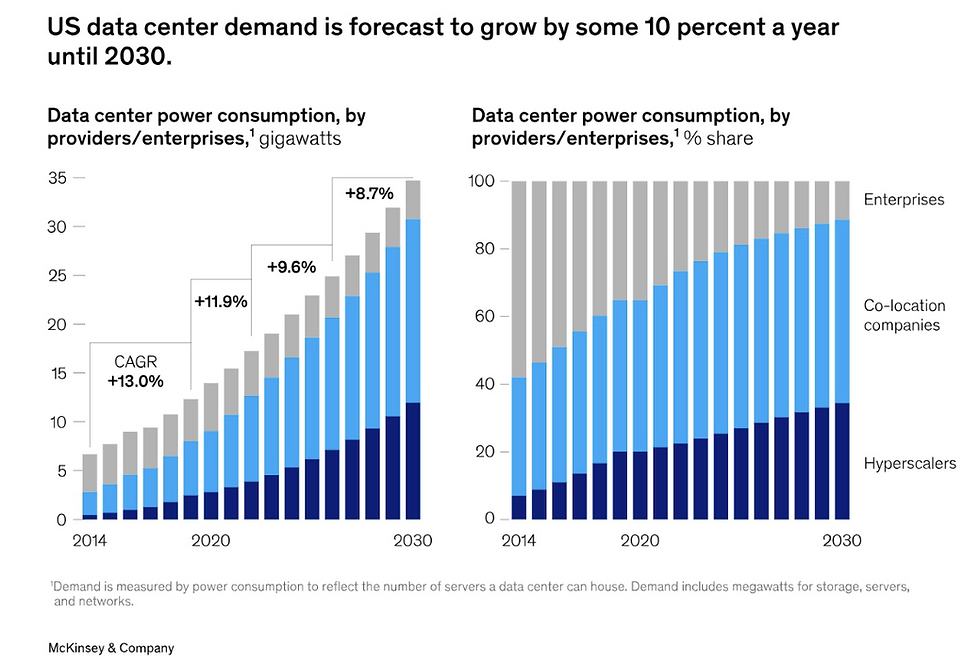
It’s a national security issue. We are a “can do” nation - at peak production during WWII, we were completing over 3 Liberty ships PER DAY; and over 41 heavy bomber aircraft per day. We can build the infrastructure - and it’s better to have a massive installation of electric power generating plants, power and fiber optic cables, and everything else needed to support these massive projects isolated from people and population centers. Indeed, the Powder River Basin coal deposits in Wyoming and Montana are perhaps the largest single coal formation in the entire world. These are low-sulfur, easily accessible coal resources, surrounded by Federal lands. It makes sense to locate the data centers close to these resources, so clean coal power plants can be built to support their Gigawatt-sized power needs. And, before dismissing the idea of clean coal-fired power plants, please research the giant strides that have been made in this technology over the past couple of decades. Or, in the alternative, since AI is a national security issue, we will just expedite the development and deployment of small modular nuclear reactors to power the data centers - the risk is mitigated since we are siting these facilities in remote areas.
By taking this simple “locate on Federal lands” approach, we protect our heritage. We protect our environment. We eliminate the squabbling over property rights. We disrupt people’s lives less. We don’t have to worry about property tax impacts or abatements. We maintain the peace of our communities. We win the AI race, and by extension protect our national security.
And perhaps most importantly, we protect the individual property rights of Texans.
Everyone wins!
(Editor’s note - this is an updated version of an article I originally posted on January 31 - the piece was drafted to cause the reader to think. We need to have a national conversation about what Artificial Intelligence actually is, and how it impacts America (and really, all of humanity). How will AI be used? What is the good in this new technology? Why is AI deemed a national security issue? How do we best protect AI infrastructure from hacking and other threats, especially since it is tied into our critical control systems and power grid? Are there alternatives to the massive data centers currently used to ‘produce’ AI? And, if AI is deemed to be truly beneficial, then how and where do we best locate the facilities that support this new technology?)
Greg S. Harrell


Comments